The first thing I did was measure out my Spelt Wheat Berries (AKA Spelt Grain). The weight is the same before and after milling, but it's easier to measure prior to milling. Once it was weighed, I ran it through my Mockmill Pro 200 on level 1.
Next I measured out the water and mixed the flour/water mixture by hand until it was fully incorporated. *Note- one or two grams isn't going to change the outcome of your bread. so the 401g of wheat and the 351g of water will work just fine.
Next we are going to let it autolyse, which means to let it rest, (covered with a tea towel) for 1 hour before adding any additional ingredients. You can read all about hydration and autolyse here.
After the autolyse, we are going to go ahead and add in the sourdough starter, salt, rosemary and the olive oil. I gently stretch and fold this in on itself and let it rest for 20 minutes before we start the next step - view the next step to see this process because we will do it a couple of times to increase gluten in our bread.
The stretch and folds are next! I simply pick up a part of the dough, stretch it up in the air and fold it over towards the center. Continue to do that all the way around your dough so that you've done a full circle. Cover and rest for 20 minutes. I like to do this 2-4 times to give the bread a good gluten structure. (Why 2-4 times? Well because you want a good gluten structure. If it's easily breaking while your doing the stretch and folds, then you need to do another round).
At this point we can start our bulk fermentation. You can do this one of two ways, depending on when you are wanting to eat this yummy bread. You can either cover with plastic wrap and 1) rest on the counter for 3 hours for same day baking OR 2) place in the refrigerator overnight (or up to a week depending on how sour you want it!).
The next step is to laminate! This may seem scary but all we're going to do here is take that risen dough and push it down with our fingers into the shape of a rectangle. Then we are going to fold it into thirds. Once, we have that trifold of dough we're going to roll is up and gently shaping the dough. This is kind of hard to show through pictures, but we are going to scrape the dough across the counter with our hands at the base of the dough and pull in towards us to give the top of the dough some surface tension.
Now I place the dough into the parchment paper lined cast iron bread pan, cover and let rest for 1 more hour.
Now we score and bake! About 10 minutes before your 1 hour time is up, I like to preheat the oven to 425 and score my bread. Scoring is the process of making shallow, intentional cuts on the surface of proofed bread dough just before baking, essential for controlling its expansion in the oven. By creating a weak spot, it directs the "oven spring" (rise), resulting in a better rise and preventing ragged, unplanned bursts on the crust. (And it's fun to be creative with!)
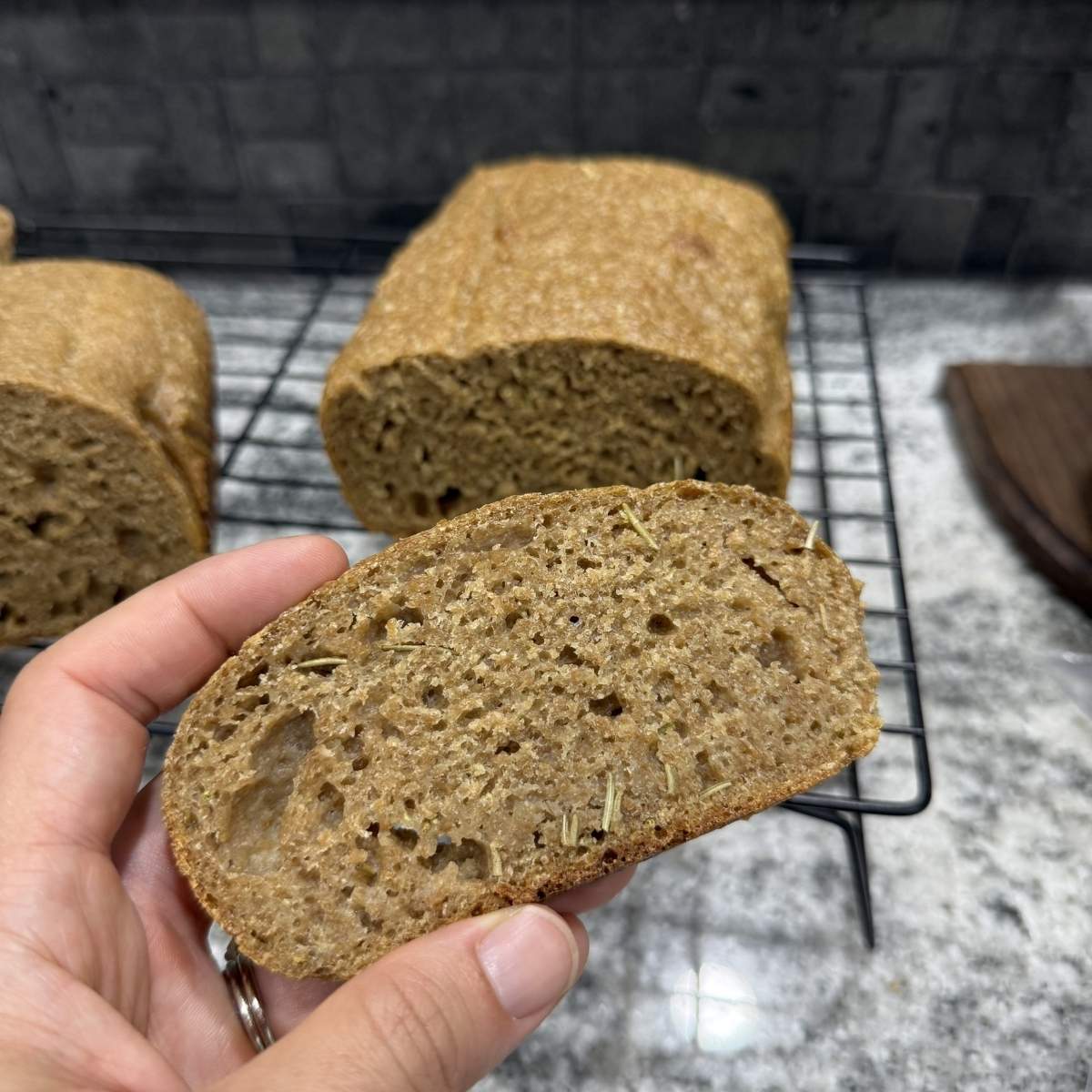
Then we bake! We are going to bake our bread in the oven at 425 for 30 minutes with the lid on, and then an additional 20 minutes with the lid off. When I remove it from the oven, I pop it out of the bread pan and place on a cooling rack and let rest for 1 hour before slicing. Pro Tip**It's super tempting to cut right into the bread, but you'll want to wait the full hour because your bread is technically still cooking. It'll still be warm after the full hour is up, but you won't have a gummy or dense consistency if you wait.
Time to slice and eat! Top with butter or jam or eat plain...any of it is going to be delicious! I used my new manual bread slicer that my kids got me for Mother's Day and I love it! It makes slicing the bread easy and you'll get even slices!